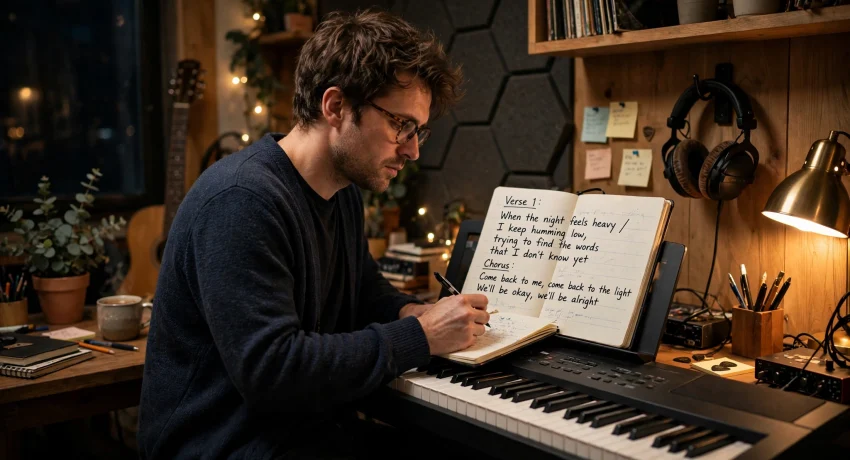
Every song you love started as something unfinished: a few chords, a line in a notebook, a melody hummed into a phone. The difference between that rough beginning and the finished song is craft — the patient, unglamorous work of turning a good idea into something that lasts.
This is the other side of what makes music successful. Our companion piece looks at the qualities listeners feel — melody, emotion, lyrics, groove. This one looks at the work behind them: the songwriting discipline, the arrangement, the production choices and the habit of finishing. None of it is glamorous. All of it is what separates a song people forget from a song they keep.

1. Songwriting Discipline: Write, Finish, Revise
The first part of the craft is the least romantic: showing up. Successful songwriters write regularly, finish songs even when the first draft is weak, and revise without mercy. A finished imperfect song teaches you more than ten perfect openings that were never completed.
Revision is where most of the quality comes from. The first version of a lyric is usually a rough sketch of the idea. The second and third versions are where the vague lines become specific, the extra words get cut, and the chorus earns its place. If a line does not serve the song, it goes — even if you liked writing it.
2. Arrangement: Space and Dynamics
Arrangement is the art of deciding what plays when — and, just as importantly, what does not play. A song that has everything playing at once from the first second has nowhere to go. The songs that hold attention usually start small and grow: a voice and one instrument, then a little more, then the full sound at exactly the right moment.
Space is part of the arrangement too. A pause before the chorus, a bar where the drums drop out, a verse that is nearly bare — these silences make the loud moments feel loud. Dynamics, the rise and fall of a song’s energy, are what keep a listener from tuning out halfway through.
3. Sound Choices and Production
Production is the set of choices about how a song sounds: which instruments, which tones, how the voice sits in the mix. The craft here is restraint. Every sound should earn its place, and the production should serve the song rather than show off.
That means choosing instruments that fit the feeling — a warm piano for an intimate song, a driving beat for an energetic one — and keeping the vocal clear enough that the words can be heard. It also means knowing when to stop adding. Many songs are ruined not by what is missing but by one layer too many.
4. Collaboration: Letting Others In
Very few successful songs are made entirely alone. A co-writer hears what you cannot, a producer suggests the change you were avoiding, a musician plays a part you would never have imagined. Collaboration is not a sign that the songwriter could not do it alone — it is how good songs become better.
The craft of collaboration is listening without defensiveness. The best response to a suggestion you dislike is not to argue but to try it once. If it does not work, you have lost an hour. If it does, you have a better song.
5. Consistency and Finishing
The musicians whose work lasts are rarely the ones with a single brilliant idea. They are the ones who finish songs, release them, learn from the response, and start the next one. Consistency builds skill faster than inspiration does, because every finished song teaches something the unfinished ones cannot.
Finishing also means letting go. There comes a point where more revision stops improving a song and starts wearing it out. Knowing when a song is done — and releasing it — is itself a skill, and it is one of the hardest to learn.
If you want the listener’s side of this story — the qualities you feel when a song works — read our guide to the essential qualities of highly successful music. For why music holds us at all, see our piece on the love of music and why we can’t get enough of it.
What the Craft Cannot Do
Craft alone does not make a song successful. A technically perfect song with no feeling in it will be forgotten, while a rough song with honest emotion can last for decades. The craft is not a replacement for feeling — it is the way feeling reaches the listener clearly. The best songs have both: something real to say, and the skill to say it well.
FAQ: The Craft Behind Successful Music
Do I need expensive equipment to write good songs?
No. Many lasting songs were written on a cheap guitar or a phone. Equipment affects sound quality, not song quality. A good song works even when it is played on one instrument in a quiet room.
How do I know when a song is finished?
When further changes stop making it clearly better. If you are changing lines back and forth without improvement, the song is probably done — record it, release it, and start the next one.
Is collaboration necessary?
Not necessary, but it helps most songwriters. Even one honest listener — someone who will tell you which verse drags — can improve a song more than another week alone with it.
Final Thoughts
Behind every song you cannot forget is work you never see: drafts rewritten, arrangements simplified, sounds chosen with care, and the discipline to finish and let go. The craft behind highly successful music is not a secret. It is showing up, writing honestly, arranging with space, producing with restraint, and finishing what you start. The feeling is what makes a song worth hearing — the craft is what makes sure it is heard.