Think about the last glass of clean water you drank, the air filtered in a modern building, or a medicine made pure enough to inject safely. Behind each of those everyday things sits the same quiet idea: taking a mixture apart and keeping only what you want. That is separation technology — a family of methods used across industry, healthcare, and environmental protection to isolate, purify, and recover materials.
Separation sounds simple, but the mixtures involved rarely are. A wastewater stream, a fermented broth, a mined ore, or a chemical reaction product may contain dozens of components with similar sizes, densities, or chemical behaviour. Choosing the right method — or, more often, the right combination of methods — is what makes the difference between a clean product, a wasted resource, and an expensive failure.
What Separation Technology Actually Means
At its simplest, separation technology isolates one or more components from a mixture. The goal may be purification (removing contaminants), recovery (getting a valuable material back), concentration (raising the strength of a desired component), or classification (sorting particles by size or density). The best method depends on what differs between the components: their size, weight, solubility, boiling point, charge, magnetism, or affinity for a particular surface.
That is why there is no single “separation machine.” A water plant, a pharmaceutical factory, and a recycling plant may all use separation, but they use very different tools, because they are solving very different problems.
The Main Methods, Explained
Filtration and Sedimentation
Filtration passes a mixture through a barrier that holds back solids while letting liquid or gas through — from a coffee filter at home to industrial filter presses. Sedimentation uses gravity: heavier particles settle, and the clearer liquid above can be drawn off. Both are simple, widely used first steps, though neither can separate dissolved substances on its own.
Centrifugation
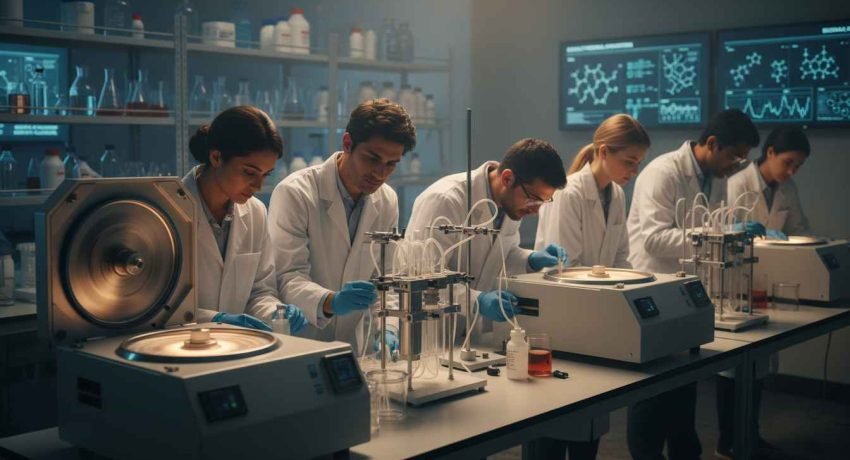
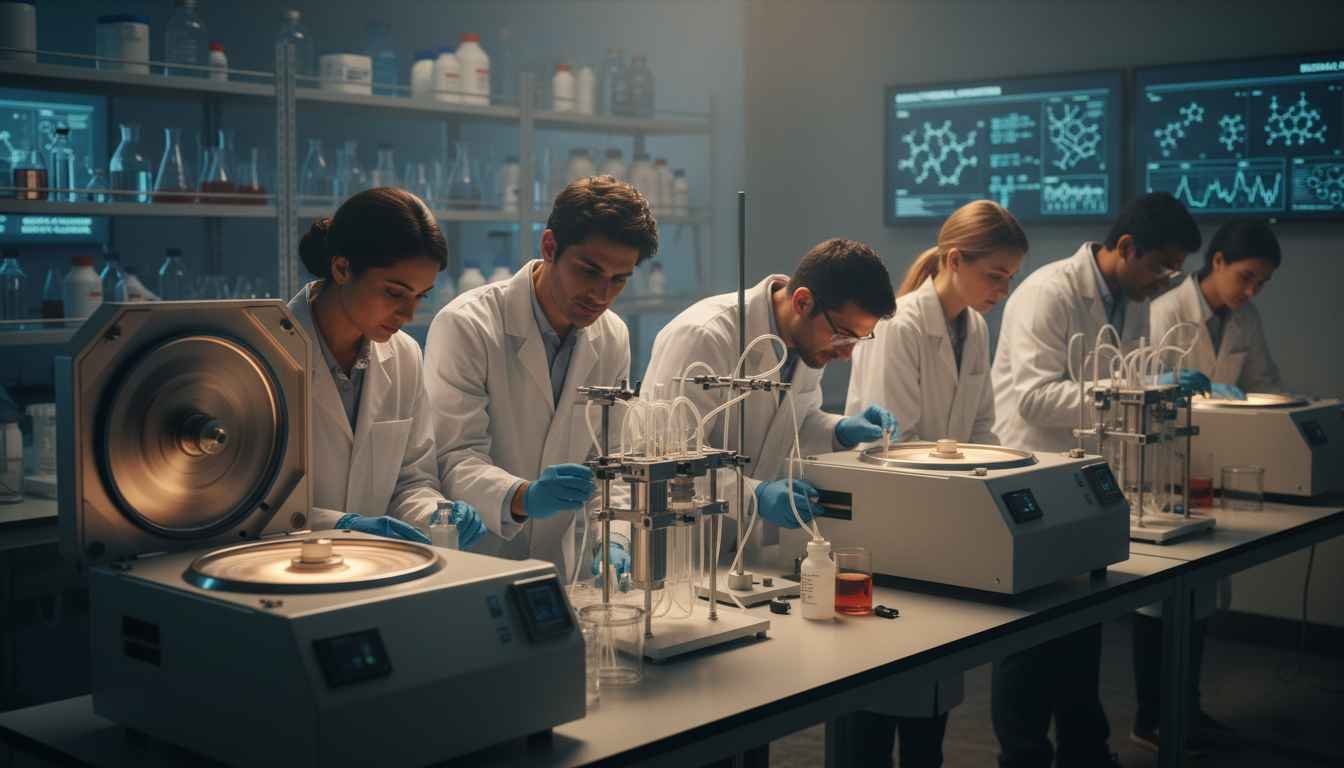
A centrifuge spins a mixture at high speed, forcing denser components outward. Clinical laboratories use centrifugation to separate blood components for testing, and industry uses it to clarify liquids, separate cream, and recover fine solids. It is fast and effective, but equipment and energy costs rise with scale and speed.
Distillation and Evaporation
Distillation heats a liquid mixture so that components with lower boiling points vaporise first, then condenses the vapour back to liquid. It is a workhorse of chemical manufacturing and spirit production, but it is energy-hungry, and it struggles when components have very close boiling points or degrade with heat.
Membrane Separation
Membranes are selective barriers with tiny pores or specially designed surfaces. Microfiltration and ultrafiltration remove particles and large molecules; reverse osmosis, which forces water through a very fine membrane, can remove dissolved salts and is widely used in desalination and high-purity water production. Membranes are powerful, but they foul — material builds up on the surface — and fouling raises costs unless cleaning and pre-treatment are well managed.
Chromatography and Adsorption
Chromatography separates components by how they interact with a stationary material as a fluid carries them past it; different components travel at different speeds and emerge separately. It is essential in pharmaceutical purification and analytical laboratories, where purity requirements are extremely high. Adsorption, a related idea, captures a target substance on a surface — activated carbon removing tastes and odours from water is a familiar example.
Solvent Extraction, Crystallisation, and Magnetic Separation
Solvent extraction moves a target component into a second liquid in which it dissolves more readily. Crystallisation grows pure crystals from a solution, a classic route to purified salts and pharmaceutical ingredients. Magnetic separation pulls magnetic materials from a stream and is widely used in mining and recycling, where it can sort metals quickly and cheaply.
Where Separation Technology Is Used
Water and Wastewater Treatment
Water treatment is the most visible application. Screening and sedimentation remove debris and grit, filtration and membranes polish the water, and disinfection follows. Wastewater plants use the same family of methods in reverse: recovering clean water for reuse, concentrating sludge for treatment, and removing nutrients that would otherwise harm rivers and seas. As water scarcity grows, the ability to treat and reuse water — rather than simply dispose of it — makes separation central to sustainability planning.
Air Pollution Control
Separating particles and gases from exhaust streams protects both workers and surrounding communities. Filters, electrostatic precipitators, and scrubbers remove dust, droplets, and soluble gases before air is released. The right choice depends on particle size, gas composition, temperature, and how the captured material will be handled afterwards.
Healthcare and Biotechnology
In healthcare, separation underpins diagnostics and manufacturing. Blood component separation supports testing and transfusion, while filtration and chromatography purify proteins, antibodies, and other biological molecules for medicines and vaccines. Purity here is not cosmetic: a contaminant in a drug product can change its safety and effectiveness, which is why pharmaceutical separation is tightly controlled and validated.
Manufacturing, Mining, and Recycling
Chemical plants use distillation, extraction, and crystallisation to refine raw materials and separate by-products for reuse. In mining, flotation and gravity separation help recover valuable minerals from ore, reducing the amount of rock that must be processed further. In recycling, mechanical and magnetic sorting — and increasingly, sensor-based sorting — separate metals, plastics, and paper so each stream can be reprocessed properly. Recovering materials this way saves raw inputs and landfill space, though sorting quality decides whether the recovered material is actually usable.
Benefits — and Real Limitations
The benefits are genuine: cleaner water and air, purer products, recovered resources, less waste, and lower demand for virgin raw materials. But separation is not free. Some methods consume a great deal of energy; membranes foul and need replacement; high-purity processes need skilled operators and careful validation; and a method that works beautifully in a laboratory may be uneconomic at industrial scale. Small operations, in particular, should weigh capital cost, energy use, maintenance, and the cost of disposing of the separated waste stream — separation rarely makes unwanted material vanish, it moves it somewhere it can be handled.
How to Choose a Separation Method
Engineers usually start with the mixture itself: What are the components, and how do they differ? What purity is actually required — drinking-water standard, pharmaceutical grade, or simply “good enough to reuse”? What volumes are involved, and how much energy, space, and operator attention is available? A practical approach is to pilot the leading option at small scale before committing, and to plan for the waste stream from the beginning. If a vendor promises a single technology for every mixture, treat that as a sales claim, not engineering advice. In digital systems, a different kind of sorting happens — for context on how technology classifies and identifies information, see our guide to Wdroyo technology and what IP-intelligence tools actually do.
FAQ: Separation Technology
What industries benefit most from separation technology?
Water treatment, chemicals, pharmaceuticals and biotechnology, food processing, mining, and recycling all depend on it daily, though the methods they use differ widely.
Is membrane filtration the same as reverse osmosis?
No. Reverse osmosis is one type of membrane process, using a very fine membrane to remove dissolved salts and small molecules. Other membrane processes use larger pores and remove particles or large molecules only.
Can separation technology make any mixture pure?
Not economically, and sometimes not at all. Components that are chemically very similar are hard to separate, and each additional stage of purification costs more energy and money for a smaller gain.
What is the biggest practical problem with membranes?
Fouling — material building up on the membrane surface and reducing flow. Good pre-treatment, cleaning routines, and realistic replacement budgets are part of any serious membrane design.
Final Thoughts
Separation technology rarely makes headlines, yet it quietly decides whether water is safe, medicines are pure, and materials are wasted or recovered. Its strength is its variety: a dozen different principles, each suited to a different kind of mixture. Understand what you are separating, how pure it needs to be, and what the waste stream will cost you — and the right method usually reveals itself. That disciplined, mixture-first thinking is what turns a generic technology label into a genuinely useful industrial solution.