South Korea compresses a remarkable amount of variety into a country smaller than most US states. You can bow at a 600-year-old palace in the morning, hike a volcanic peak by afternoon, and end the day in a neon-lit food market eating seafood you watched come off the boat. The best places to visit in South Korea reward travelers who mix the obvious icons with one or two slower stops — here is how to do exactly that.
1. Seoul: Palaces, Hanok Streets, and Modern Districts
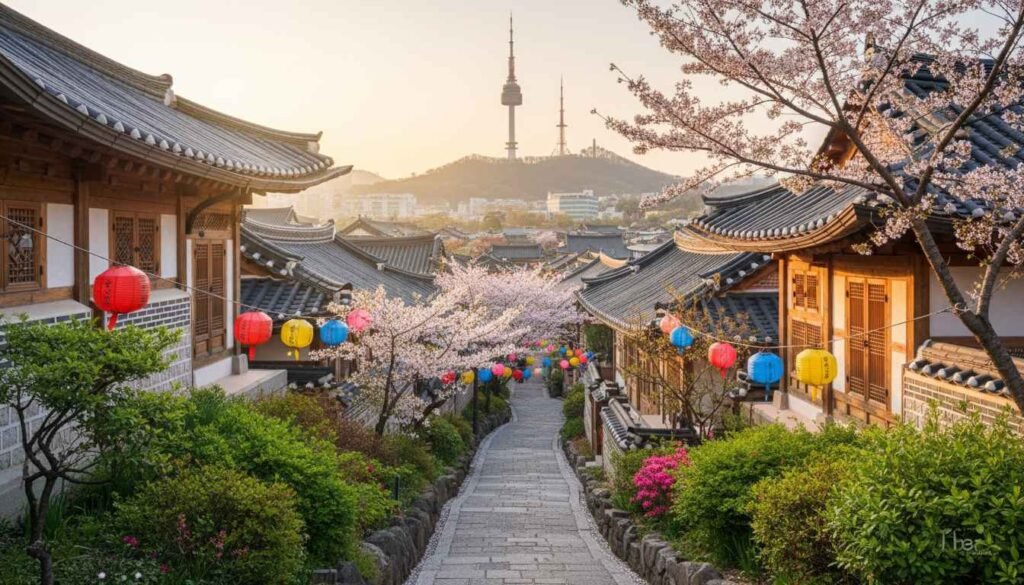
Start in the capital, where the old and the futuristic share the same subway map. Gyeongbokgung Palace, built in 1395, is the grandest of Seoul’s five Joseon-era palaces — time your visit for the changing-of-the-guard ceremony at the main gate. From there, walk to Bukchon Hanok Village, a hillside neighborhood of preserved traditional houses that still functions as a residential area (keep your voice down and stay on the marked lanes).
For the modern side, Myeongdong’s pedestrian streets are the country’s most famous shopping and street-food strip, while Gangnam shows off the sleek, high-rise Seoul of the global imagination. If you want a focused look at the district, our guide to the best places to visit in Gangnam Seoul covers its temples, malls, and nightlife in detail. Finish a Seoul day at N Seoul Tower on Namsan Mountain for the classic city panorama.
2. Jeju Island: Volcanic Landscapes and Island Calm
A one-hour flight south of Seoul, Jeju is South Korea’s favorite domestic getaway and a UNESCO Global Geopark. The island’s centerpiece is Hallasan, a dormant volcano and at 1,947 meters the country’s highest peak — the sunrise hike to the crater is a rite of passage, but start early and check trail conditions, as weather closes routes often. Elsewhere on the island you will find lava-tube caves, the Seongsan Ilchulbong tuff cone rising straight from the sea, and a ring of black-sand and white-sand beaches. Jeju’s pace is deliberately slower than the mainland, which is exactly the point.
3. Gyeongju: The Museum Without Walls
For thirteen centuries Gyeongju was the capital of the Silla Kingdom, and the entire city reads like an open-air museum — locals call it exactly that. The UNESCO-listed Bulguksa Temple and the nearby Seokguram Grotto, with its serene stone Buddha facing the East Sea, are the headline sights. But do not skip Daereungwon, the park of grass-covered royal burial mounds (tumuli) you can walk among, or the reconstructed Cheomseongdae observatory, one of the oldest astronomical structures in Asia. Gyeongju rewards at least one overnight stay; the mounds and temples photograph best in the soft light of early morning.
4. Busan: Beaches, Markets, and Mountain Temples
South Korea’s second city feels entirely different from Seoul — warmer, saltier, and more relaxed. Haeundae Beach is the famous crescent of sand, busy in summer and pleasant for a walk year-round. The real flavor is at Jagalchi Fish Market, the country’s largest seafood market, where you can pick a live fish downstairs and have it prepared upstairs. For color, head to Gamcheon Culture Village, a former hillside shantytown repainted in pastels and now packed with murals, studios, and cafes. And for quiet, the seaside Haedong Yonggungsa Temple sits dramatically on ocean cliffs, one of the rare Korean temples built by the water rather than in the mountains.
5. Beyond the Big Four: Incheon and Daejeon
If you have extra days, the areas around Seoul add worthwhile depth. Incheon’s Chinatown and the waterfront at Songdo show the port city that greets most international arrivals, while Daejeon — a science and technology hub in the country’s center — offers hot springs, the Expo Science Park, and far fewer tourists. Neither replaces the big four, but both give you a look at everyday Korea outside the postcard circuit.
Planning Your South Korea Trip
When to go: April brings cherry blossoms and mild weather; October and November bring spectacular fall foliage and clear skies. Summer (July–August) is hot, humid, and rainy. Winter is cold but dry, with good skiing in the northeast.
Getting around: The KTX high-speed rail connects Seoul, Daejeon, Gyeongju (via Singyeongju station), and Busan in 2–3 hours. Jeju is reached by budget flights from Gimpo Airport. The T-money card covers subways and buses nationwide.
How long: Ten days to two weeks lets you do Seoul (4 days), Jeju (2–3), Gyeongju (1–2), and Busan (2) without rushing. A single week still works if you pick Seoul plus one of Jeju or Busan.
FAQs
Is South Korea expensive to visit?
Mid-range by Asian standards. Budget travelers can manage on guesthouses, street food, and the excellent public transit; a comfortable mid-range trip runs roughly what Western Europe costs, minus the museum-heavy days since many palaces and temples are cheap to enter.
Do I need to speak Korean?
No. English signage is widespread in Seoul, Busan, and tourist areas, and translation apps handle the rest. Learning to read Hangul — the Korean alphabet, which takes most people an afternoon — helps enormously with signs and menus.
What is the best first-time itinerary?
Seoul for history and city life, Jeju for nature, and Busan for coastal culture gives you the full arc. Gyeongju is the pick for history lovers willing to trade a beach day for ancient temples.
Final Thoughts
South Korea’s best places share a pattern: deep history worn lightly, nature that is easy to reach, and cities that never quite sit still. Whether you come for the palaces, the volcanic island, the ancient capital, or the seafood markets, the country rewards the traveler who slows down between the highlights. Plan for the season, ride the KTX, and leave room in the schedule for the neighborhood you stumble into by accident — that is usually where the trip happens.